
Persian Ferdows Rug
Description
This Persian Ferdows rug dates to around 1900.
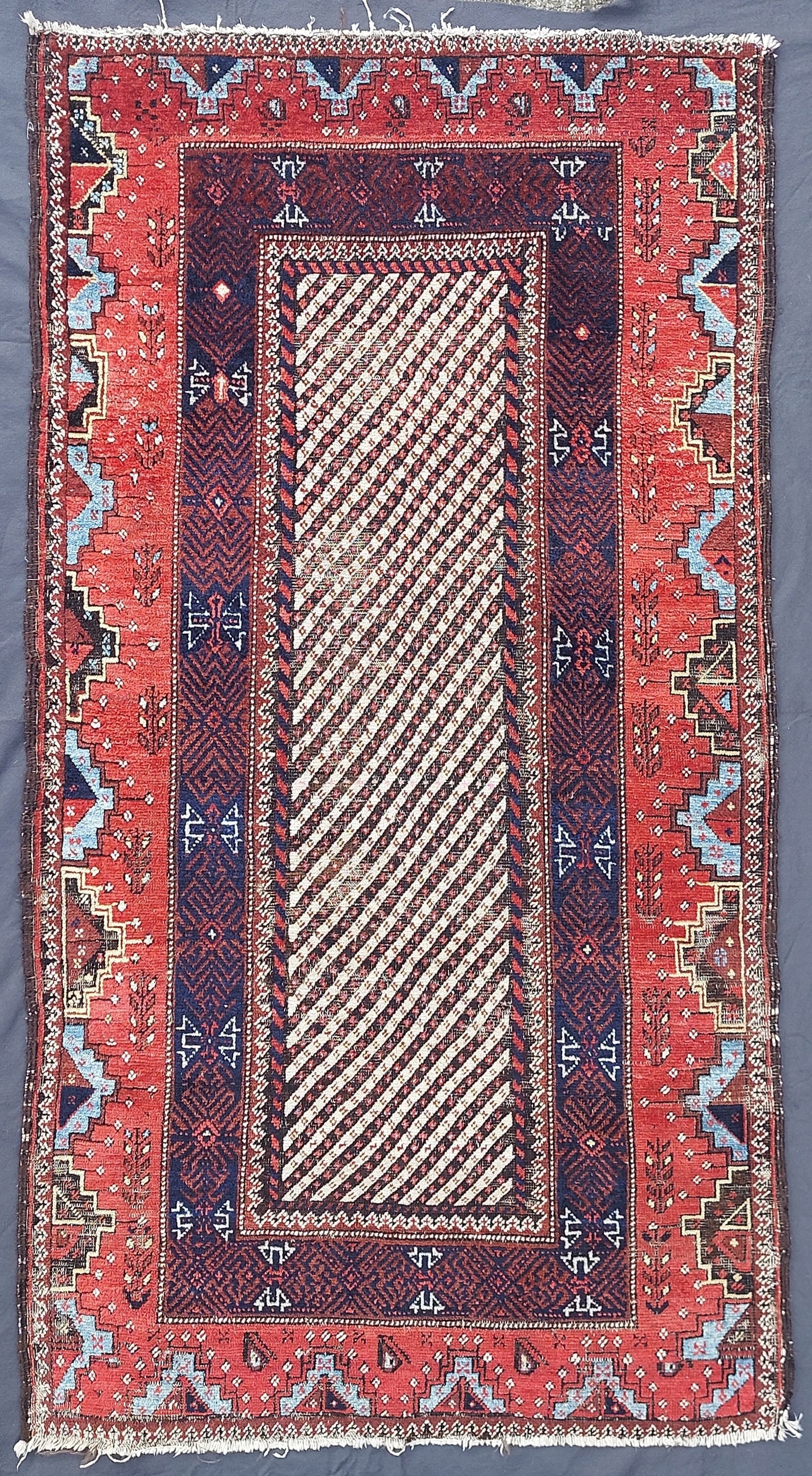
The field design is a sequence of alternating diagonal lines in white and black with cruciform little emblems in brown and yellow on the white and red and light blue on the black lines. Around the middle of the field there is a horizontal line of these small emblems in pink silk. Multiple geometric patterns frame the field: diagonal lines in red and blue, a reciprocal pattern in brown and black off set by white outlines and a guard stripe in the same colours. This is followed by a very dark border on a black ground with brown cartouches, slightly lightened by the addition of a small red diamond centre and some white in the spaces in between.
The main border on a soft red ground with half-guls protruding inwards introduces a lighter colour scheme with the strong presence of light blue and, to a lesser extent, yellow. This arrangement lifts the visual impact of the rug and counterbalances the white of the field.
This village rug was made by a Balouchi weaver; it is worked with a Persian knot open to the left in wool on a cotton warp and a brown woollen weft. In keeping with age, the black is slightly corroded due to the iron mordant used in the dyeing, which produces a minimal high-low effect in the pile.
A Balouch rug with the same field design but very different border arrangements is published as Plate 8 in Black, David & Clive Loveless, Rugs of the Wandering Baluchi. London, David Black Oriental Carpets 1976. They suggest that the field design is “distinctly unusual and is probably derived from the Qashqai” (op.cit., Pl. 8) – an attribution which we do not find entirely convincing. Afshar rugs, however, are not uncommon with this design.
The rug has areas of wear but is still in usable condition and is priced accordingly.