
Persian Bidjar Rug
Description
This Bidjar rug from the Kurdish part of northwestern Iran was made in around 1900.
With its dense weave, which is characteristic of rugs from this area in Garrus Province, it is a sturdy example of traditional village weaving.
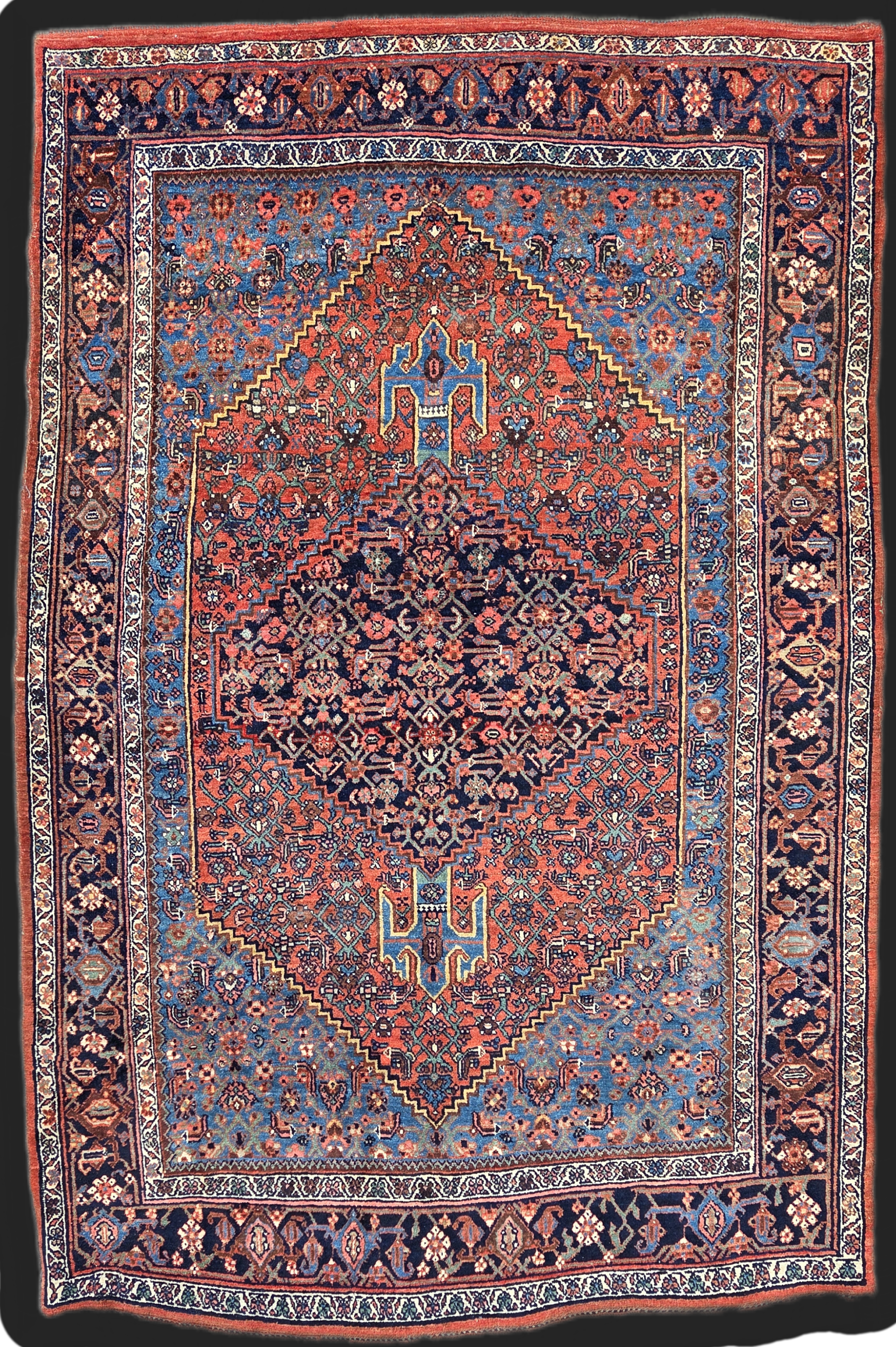
A dark blue anchor medallion, with the “anchors” held in light blue, is set inside a large stepped hexagon on a soft red ground. This as well as the “anchors” are framed by a yellow line giving the whole rug a visual lift. The same light blue that dominates the “anchors” surrounds the red hexagon, so the over all impression is one of softness in the colours. The patterning of the whole field is a Herati design, with the exception of the “anchors”, which are very sparsely decorated and feature a small reciprocal element in white and black – possibly an amulet. (Another Bidjar carpet with the classic Herati design, which was recently added to this website, is a large kelleh, see https://www.christopherleggeorientalcarpets.com/products/view/bidjar-kelleh-long-rug/ ).
A sequence of three borders frames the rug: two meandering borders with small flower heads on a white ground enclose the main border on a dark blue ground, again with floral motifs as the main pattern.
The weaver of this rug employed a large number of different, naturally dyed colours, we counted 14: three shades of blue, two greens, two reds, two yellows and two browns, plus one each of pink, black and white, the latter undyed wool. She obviously took great care in the process of weaving. The choice of colours but also the execution of the design are indicative of her considerable skill.
The rug is woven in wool on a wool foundation with a Turkish (symmetrical) knot on a warp on two levels. It is in excellent condition, including the original soumak stitched decorative end finishes.