
Bidjar Kelleh (Long Rug)
Description
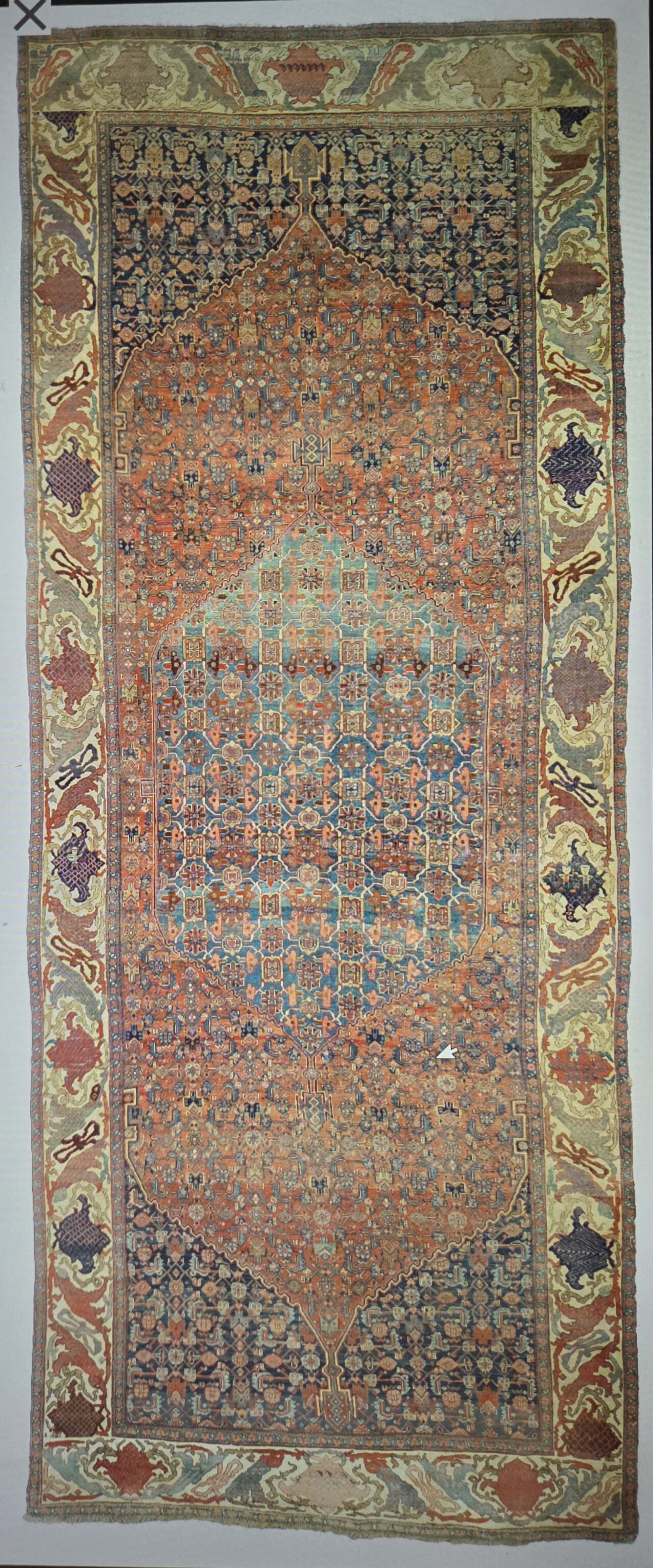
This large Persian Bidjar kelleh, or long rug, dates to the middle of the 19th century and was made in the Kurdish part of northwestern Iran.
It is a magnificent example of village weaving and was almost certainly made for, and probably in, a khan’s house.
The field is generously divided into two main sections, the centre being what could be interpreted as an anchor medallion on a light blue ground. This is placed inside another, much larger, anchor medallion on a light red ground. The spandrels at each end of the carpet are on a dark blue ground. Both the spandrels and the red medallion are decorated with an elaborate Herati design. The patterning in the blue medallion is a curious mix of a highly stylized Herati design and the Mina Khani pattern with a strong element of straight lines forming almost perfect squares around the flower heads with their four corner elements.
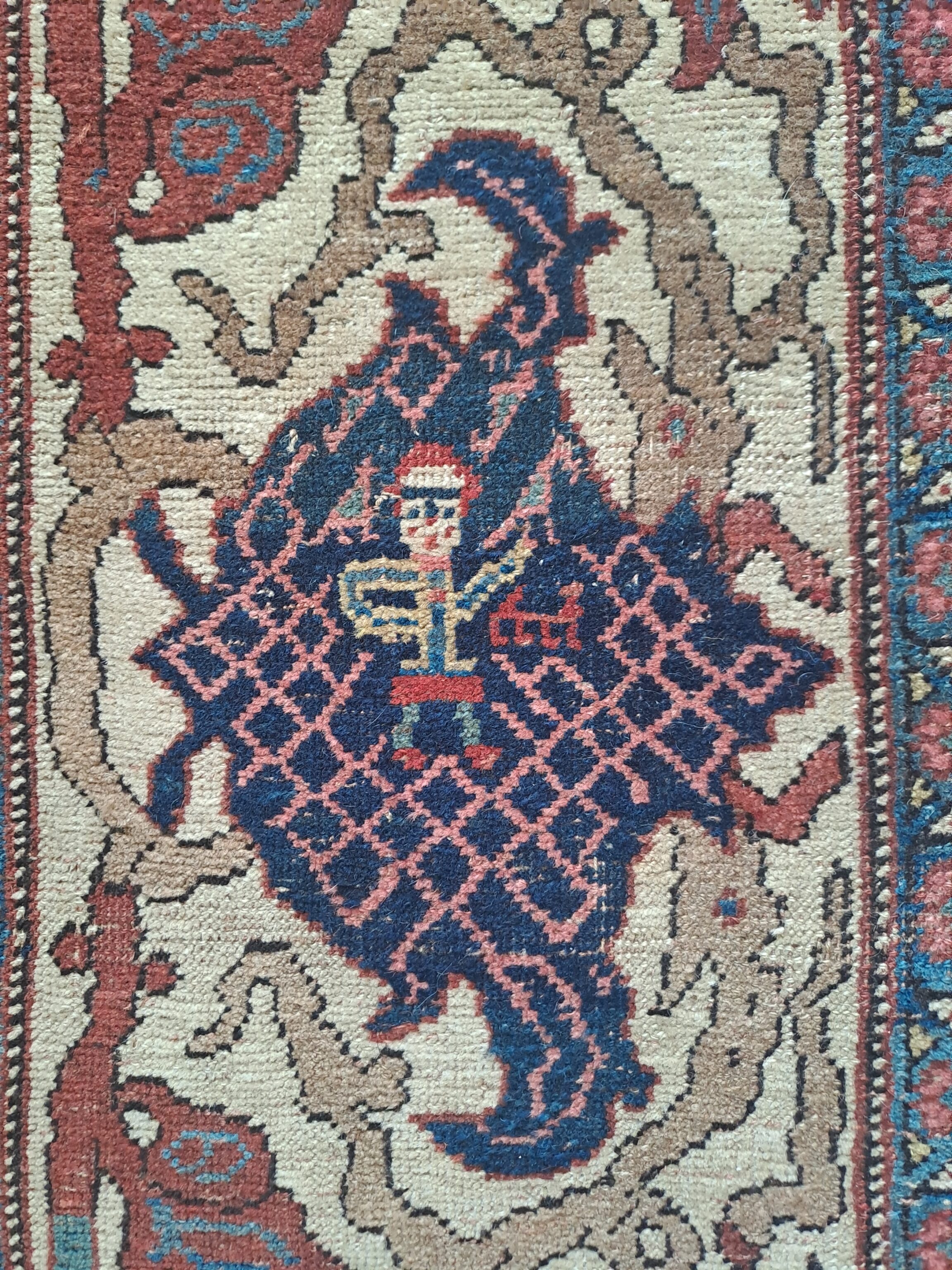
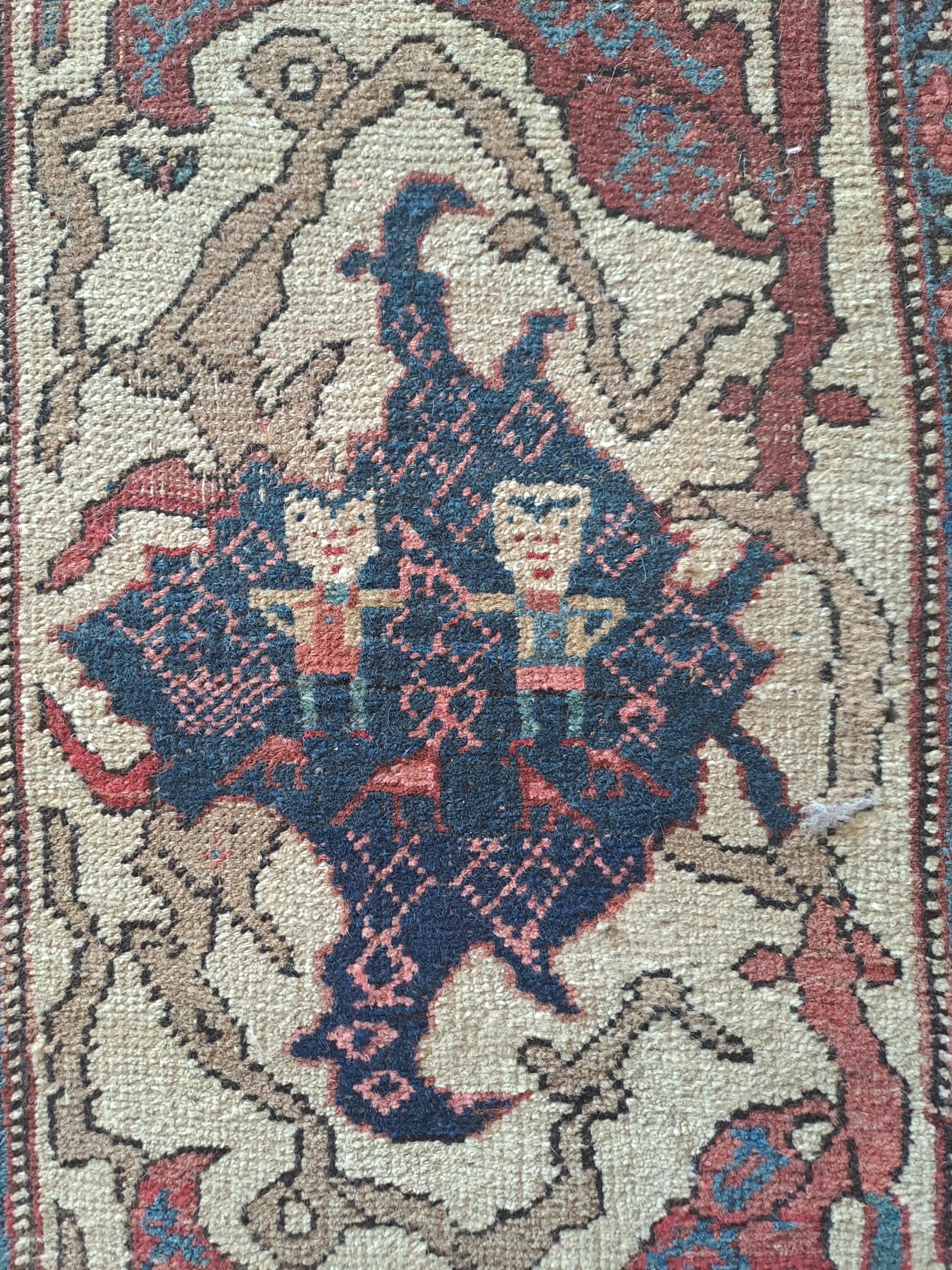
The most eye-catching feature of this grand carpet, however, is the wide border on a white ground. The sheer scale of the bold motifs (possibly zoomorphic in origin?) is breathtaking. Half-way up the carpet are figures included in the border: a falconer on the left hand side and a couple on the right hand side (see additional images). It is quite possible that this kelleh was actually commissioned for a wedding, a suggestion which is supported by the fact that white ground carpets were often associated with weddings.
The colour scheme of this carpet is subtle, which forms an interesting contrast to the flamboyance of the border design.
The carpet is woven with a Turkish (symmetrical) knot in wool on a wool foundation and is in good condition.
This is an early example of Kurdish weaving from the Garrus area, an altogether very impressive original piece.